

Naturalization Application — Support in Ishikawa & Toyama
We support the application process for those seeking to acquire Japanese nationality.
Unlike permanent residency, naturalization means becoming a Japanese national and having a new family register (koseki) — a major decision not only for the applicant, but for their family as well.
Due to an operational change effective April 2026, the review criteria for matters such as the residency requirement are shifting in practice, making it more important than ever to check your individual situation.
Please feel free to consult us first, with the latest information in mind.We support the application process for those seeking to acquire Japanese nationality.
Unlike permanent residency, naturalization means becoming a Japanese national and having a new family register (koseki) — a major decision not only for the applicant, but for their family as well.
Due to an operational change effective April 2026, the review criteria for matters such as the residency requirement are shifting in practice, making it more important than ever to check your individual situation.
Please feel free to consult us first, with the latest information in mind.
- What is Naturalization
- The Naturalization Process
- The 7 Requirements for Naturalization
- About the New Standards Effective April 2026
- Frequently Asked Questions
- Fees
What is Naturalization / How It Differs From Permanent Residency
Naturalization refers to a person who does not hold Japanese nationality acquiring Japanese nationality.
The application procedure required for this is called a naturalization application.
How It Differs From “Permanent Resident” Status
A common question is what exactly the difference is between naturalization and obtaining “Permanent Resident” status. While these are easy to confuse, there’s a clear distinction: naturalization means “acquiring Japanese nationality and living as a Japanese national,” whereas being a Permanent Resident means “holding the right to reside in Japan indefinitely, as a foreign national.”
Once naturalized, you become a Japanese national — so naturally, a residence card is no longer needed, and you’re entered into a family register (koseki). You’re also granted the right to vote, and since you’re no longer a foreign national, there’s no longer any risk of deportation.
On the other hand, naturalization comes with a “loss of nationality requirement” — so if you acquire Japanese nationality, you must apply with a full understanding that you will lose your nationality of origin.
The Naturalization Process & Our Office’s Role
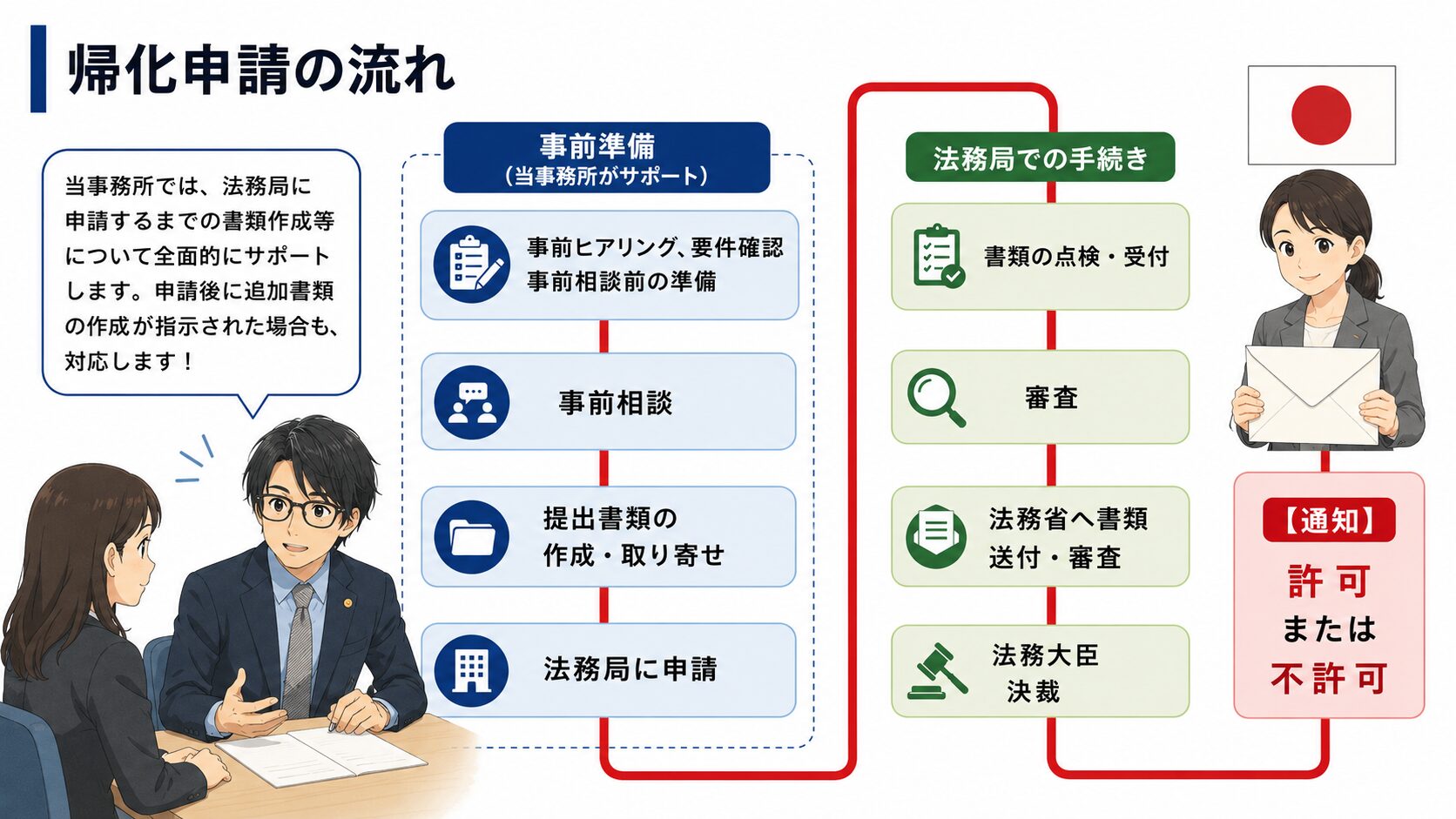
Applications for statuses of residence are made to the Immigration Services Agency, but naturalization applications are submitted to the Legal Affairs Bureau (Homukyoku) instead. Online applications are not possible.
The actual steps taken with the Legal Affairs Bureau are simple in outline:
- Preliminary consultation
- Application (followed by review and an interview)
- Notification of approval (or denial)
However, the number of matters to check and documents required is substantial.
As for the review period, it takes at least 6 months to a year from the time of application, so you’ll also need to check the remaining period of your current status of residence. If your period of stay expires after you’ve applied, you’ll need to renew it — so please be careful about this.
Before Step ① above, our office first meets with you to check whether you meet the requirements for naturalization. Once you formally request our services, we provide comprehensive support at every stage leading up to the application — including preparing the full set of naturalization application documents, advising on required documents, helping with document collection, translating foreign-language documents, and accompanying you to the Legal Affairs Bureau. Please feel free to consult us about anything you might find hard to ask the Legal Affairs Bureau directly.
Our Representative’s Experience & Approach to Naturalization
Before registering as an administrative scrivener (gyoseishoshi), our representative worked as a staff member of a supervisory organization supporting the acceptance of technical intern trainees, and has also personally gone through international marriage. He has consulted with people in many different situations — those choosing naturalization after building a life in Japan, and those torn between aiming for permanent residency or naturalization.
Permanent residency and naturalization share common ground as “options for continuing to live in Japan long-term,” but they differ greatly in nature. Permanent residency lets you reside in Japan while keeping your foreign nationality, whereas naturalization means acquiring Japanese nationality and losing your nationality of origin. There are also non-trivial practical differences — such as whether you have the right to vote, or whether you’re subject to deportation.
Which option to choose depends on your own and your family’s future plans, and your relationship with your home country. Our office values not just explaining the institutional requirements, but also being a place where you can consult us about the background behind this choice.
The 7 Requirements for Naturalization
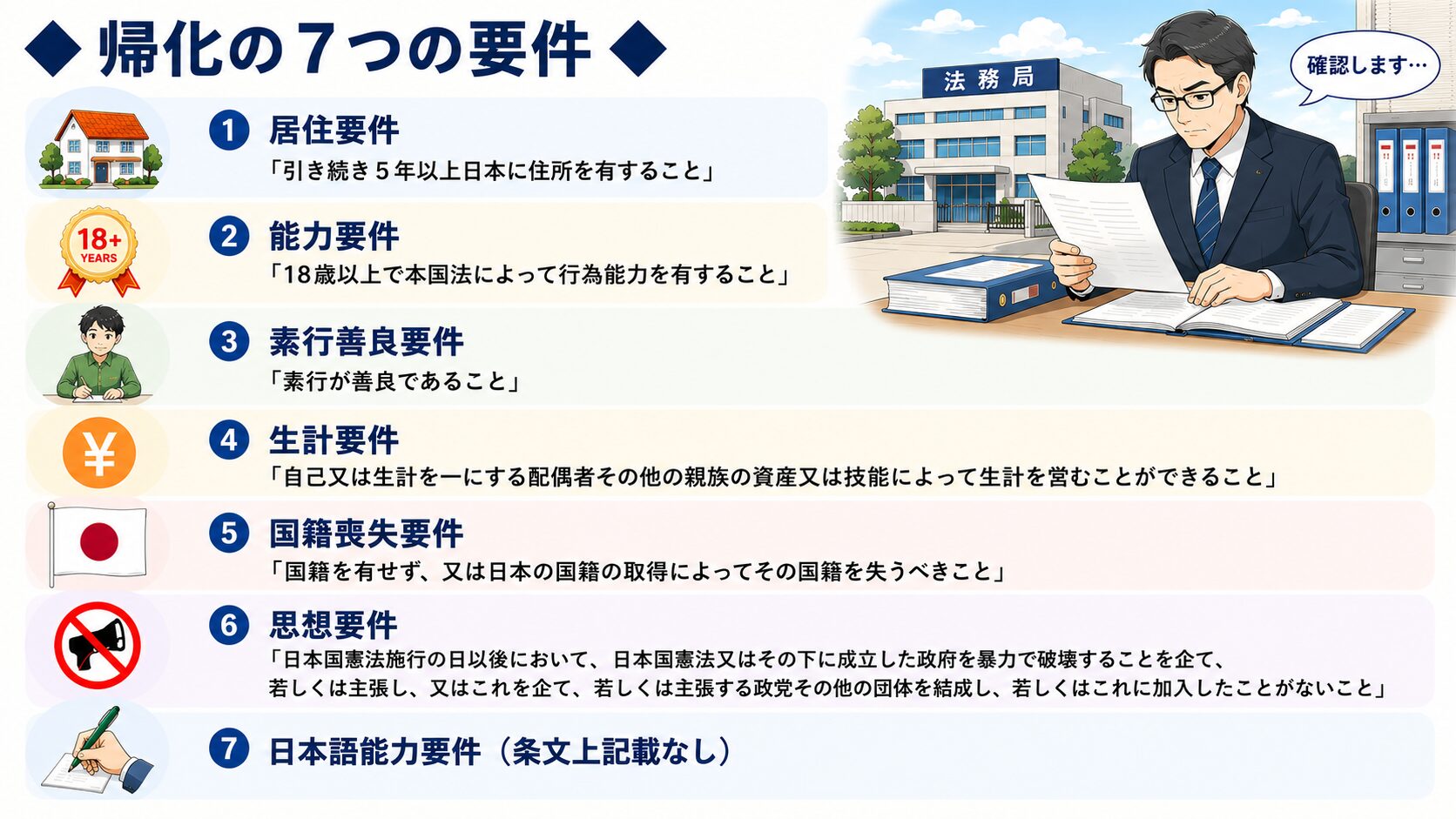
To naturalize, you must meet the following 7 requirements as set out in Article 5 of the Nationality Act.
(1)Residency Requirement
“Having continuously resided in Japan for 5 years or more.”
Within these 5 years of residence, all of the following must also be satisfied:
① No single trip abroad exceeding 3 months.
② Total days abroad per year not exceeding roughly 100–150 days.
③ A record of employment and tax payment for the most recent 3 years.
(2)Capacity Requirement
“Being 18 years of age or older and having legal capacity under the law of your home country.”
Following a revision to the Civil Code, this was lowered from “20 years or older” to “18 years or older,” effective April 1, 2022.
(3)Good Conduct Requirement
“Having good conduct.”
Those who have received a criminal penalty within the past 5 years, or who have violated obligations such as tax payment, are not approved.
(4)Means of Livelihood Requirement
“Being able to support yourself through your own assets or skills, or those of a spouse or other relative with whom you share a livelihood.”
If you’re married and have a family, it’s sufficient for your spouse to meet this requirement, even if you as the applicant do not.
(5)Loss of Nationality Requirement
“Not currently holding any nationality, or being set to lose your current nationality upon acquiring Japanese nationality.”
One of the naturalization requirements is a nationality renunciation requirement. Since some countries do not permit renunciation of nationality, this needs to be checked in advance.
(6)Ideology Requirement
“Never having planned or advocated the violent overthrow of the Japanese Constitution or the government established under it, since the day the Constitution came into effect, nor having planned or advocated the same, nor having formed or joined any political party or other organization that plans or advocates the same.”
This requirement is typically not an issue.
(7)Japanese Language Ability Requirement(Not stated in the text of the law)
This requirement isn’t listed in Article 5 of the Nationality Act, but it is required as part of the naturalization approval review. Conversational ability is important, of course, but reading and writing ability in Japanese also appears to be weighed heavily. As a general guideline, it’s considered better to have passed N1 or N2 of the Japanese Language Proficiency Test (JLPT).
The above are the requirements for standard naturalization. In cases such as when your spouse or parent is Japanese (including through naturalization), some of the above requirements are relaxed (“simplified naturalization”).
About the New Standards Effective April 2026
Please Note the Operational Change Effective April 2026
On March 27, 2026, the Ministry of Justice announced a review of the operational review process for naturalization approval, and the new standards are being applied to applications where the approval decision is made on or after April 1, 2026.
The text of Article 5 of the Nationality Act itself (“continuously for 5 years or more”) has not changed. However, it’s reported that, in actual review practice, the operation has shifted toward substantively requiring around 10 years of residence. It’s also reported that the period checked for tax payment history has been expanded from the most recent 1 year to 5 years, and the period checked for social insurance payment history has been expanded to 2 years.
It’s reported that this operational change may also apply to those who already applied before April 1, 2026 — meaning a gap has emerged between the requirements as written in the law and the actual review practice.
Whether your own situation falls under the new operational standards depends on individual circumstances, so please consult us first.
Frequently Asked Questions
- If I naturalize, what happens to my nationality of origin?
-
Since Japan generally does not permit dual nationality, acquiring Japanese nationality through naturalization means losing your nationality of origin. Depending on your home country, a nationality renunciation procedure may also be required, so it’s important to check this in advance.
- Specifically, how has the residency requirement changed under the new standards effective April 2026?
-
The text of the Nationality Act itself (“continuously for 5 years or more”) has not changed, but in practice, the operation is reported to have shifted toward requiring a longer period of residence. The periods checked for tax and social insurance payment history have also been extended. Whether this applies to your own situation requires individual assessment, so please consult us first.
- How much Japanese language ability is required?
-
This isn’t explicitly stated in the text of the law, but in addition to conversational ability, reading and writing ability tend to be weighted heavily in the review. As a general guideline, it’s reassuring to have around JLPT N1 or N2 level.
- Can my family apply for naturalization at the same time as me?
-
If each family member meets the requirements, applying at the same time is possible. In particular, if your spouse or parent already holds Japanese nationality, you may qualify for “simplified naturalization,” where some requirements are relaxed.
Fees
Our office offers an “Approval Guarantee (full refund policy)” for status-of-residence applications, under which we refund the full fee if an application is denied. However, due to the nature of naturalization, we charge 50% of the fee at the start of work and the remaining 50% at the time of filing, as compensation for “document preparation and related work leading up to the application,” regardless of the outcome.
Please note in advance that naturalization applications are not eligible for our refund guarantee policy.
Our fees for this service, when requested, are as follows.
| Service | Fee | Notes |
|---|---|---|
| Naturalization Application | ¥220,000 | Change of nationality (※Not eligible for the refund guarantee policy) |
Start With a Free Consultation — Feel Free to Reach Out
Due in part to the operational change effective April 2026, naturalization applications now require even more careful attention to your individual situation than before.
WILL Immigration Law Office offers proposals tailored to your specific circumstances. Please start by reaching out to us once.
Book Your Free Initial Consultation
Using the web form above is the smoothest way to contact us or book a consultation.
※For urgent inquiries, you’re also welcome to call us at 076-218-9852.