Dependent Visa Application Support — For Foreign Residents and Families in Ishikawa & Toyama
For foreign nationals residing in Japan under a work visa or student visa, whether you can bring your spouse or children to Japan varies greatly depending on the type of status of residence you hold.
Our office provides consistent support — from confirming your eligibility, to preparing the required documents, to a later switch to permanent residency or a spousal visa.
- What is a Dependent Visa
- Who Is Eligible / Not Eligible
- Required Documents & Procedure
- Our Office’s Strengths
- Common Cases
- Fee Schedule
- Frequently Asked Questions
What is a Dependent Visa
“Dependent” is a status of residence for the spouse and children who are financially dependent on a foreign national holding a work-related or student status of residence.
Unlike a spousal visa, which applies to those who marry a Japanese national, its distinguishing feature is that it’s a status of residence based on being a dependent family member of the foreign national — not on marriage to a Japanese national.
Your period of stay is tied to the type and duration of the supporting family member’s (the “principal’s”) status of residence. Working is generally not permitted, but by obtaining a “Permission to Engage in Activity Other Than That Permitted,” part-time work of up to 28 hours per week becomes possible.
Note that only the spouse and children living with the principal are eligible to come to Japan on a Dependent Visa — parents and siblings are not included.
Who Is Eligible / Not Eligible
Whether you can use the “Dependent” status depends on the type of status of residence held by the principal (the person being depended on). Since we receive many inquiries specifically from Technical Intern Trainees, let’s clarify this point first.
| Principal’s Status of Residence | Family Accompaniment | Notes |
|---|---|---|
| Engineer/Specialist in Humanities/International Services | Yes | The most common case |
| Specified Skilled Worker (ii) | Yes | The eligible fields are expanding |
| Specified Skilled Worker (i) | Generally No | Family accompaniment is not provided for under this system |
| Technical Intern Training | No | Family accompaniment is not provided for under this system |
| Student | Yes | Limited part-time work for the family is also possible with permission to engage in other activities |
| Highly Skilled Professional | Yes | Accompaniment by a parent, etc. may also be permitted if requirements are met |
Under the current system, Specified Skilled Worker (i) and Technical Intern Training are not eligible for “Dependent” status.
If you’re considering switching from Technical Intern Training to Specified Skilled Worker (ii) or to an Engineer/Humanities/International visa, there are cases where bringing your family becomes possible after the switch — so please consult us about your current status of residence together with your future outlook.
Required Documents & Procedure
Applying for a Dependent Visa falls broadly into two patterns, depending on whether the principal is already residing in Japan.
- Application for Certificate of Eligibility
- Documents proving your relationship with the principal (marriage certificate, birth certificate, etc., with Japanese translation attached)
- Copy of the principal’s residence card
- Copy of the principal’s passport
- The principal’s certificate of employment (or enrollment)
- The principal’s certificate of tax payment / taxable income
- The principal’s certificate of residence (jūminhyō)
- Copy of the applicant’s (family member’s) passport, and a photo
After the certificate is issued, the family member receives their visa at a Japanese embassy or consulate in their country and comes to Japan.
- Application for Permission to Change Status of Residence (or Application for Extension of Period of Stay)
- Copy of passport and residence card
- Documents proving the relationship with the principal
- The principal’s certificate of employment (or enrollment)
- The principal’s certificate of tax payment / taxable income
- The principal’s certificate of residence (jūminhyō)
The Procedure (Common to Both Patterns)
- Initial consultation (confirming the principal’s status of residence and income situation)
- Gathering and preparing required documents
- Filing with the Immigration Services Agency
- Receiving the residence card after approval
Document gathering often requires the cooperation of the principal’s workplace, such as for their tax certificate or certificate of employment. Our office also guides you through the process when coordination with the principal’s employer is needed.
Our Office’s Strengths
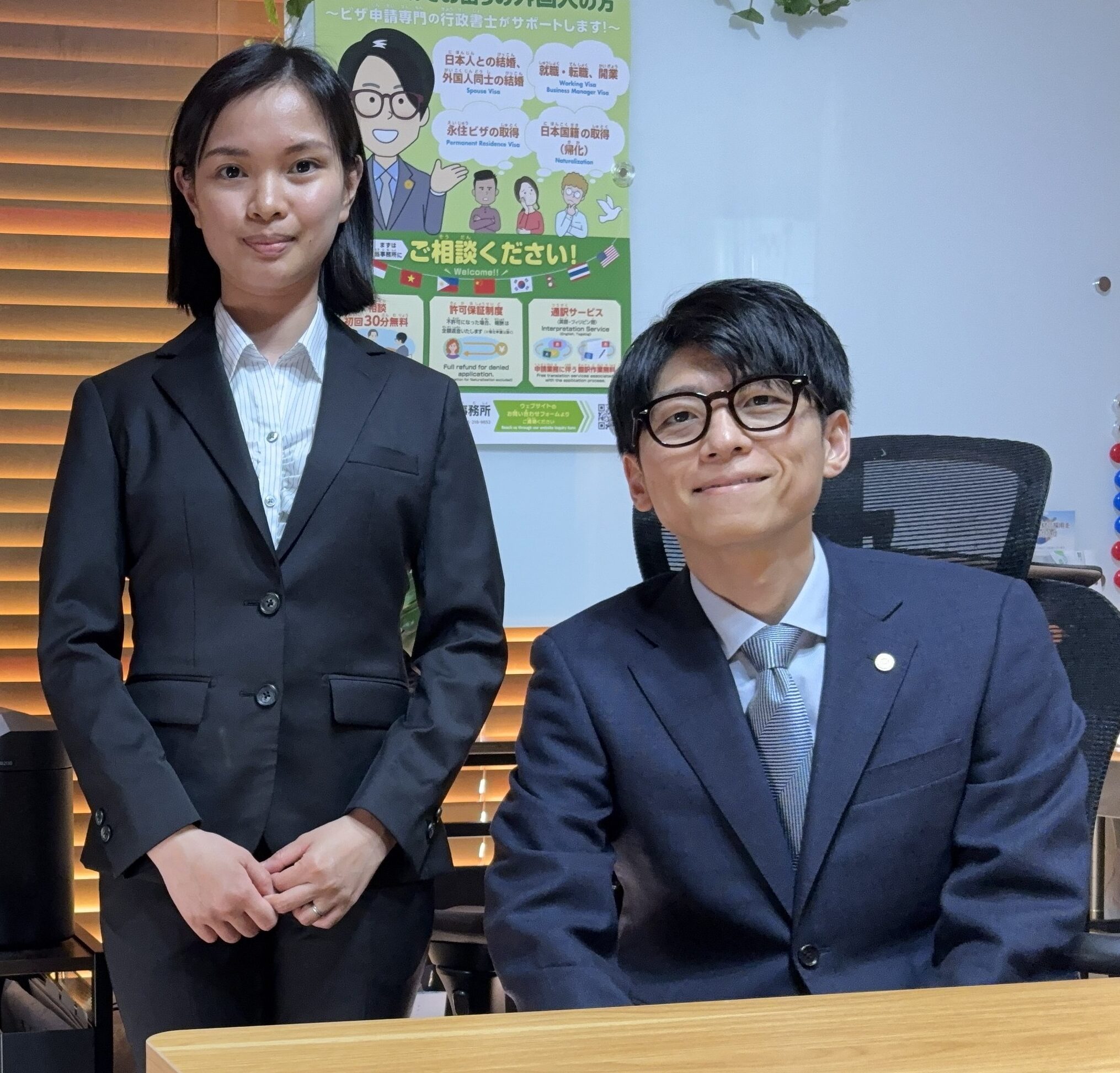
代Our representative, as a staff member of a supervisory organization supporting the acceptance of technical intern trainees, spent a long time in contact with foreign nationals working in Japan apart from their families.
He has firsthand experience seeing, in the field, just how much weight “working apart from family” carries for the person and their family — beyond the paperwork itself.
The review for a Dependent Visa mainly involves what looks like administrative document work — confirming the principal’s residence status and income — but behind it lies the earnest wish to “live together with family.”
Our office doesn’t just prepare the paperwork — we also provide consultation looking ahead to a later permanent residency application, or a switch to a spousal visa if you go on to marry a Japanese national.
Common Cases
When both the principal and family have resided stably in Japan for a long period, some consider applying for permanent residency while still on a Dependent Visa.
However, since a Dependent Visa is an inherently less stable status tied to the principal’s status, the permanent residency review requires its own separate confirmation of requirements.
If someone residing on a Dependent Visa marries a Japanese national, switching to a “Spousal Visa” becomes possible. Since this is a change from a status based on your relationship to the principal, to a status based on marriage, the required documents and the review’s focus change significantly.
At the point when the principal transitions from Technical Intern Training to Specified Skilled Worker (i), Dependent status is generally not permitted.
After that, if they move on to Specified Skilled Worker (ii), or switch to an Engineer/Humanities/International visa by meeting the academic and other requirements, bringing family becomes possible. When considering a change to the principal’s status, we recommend also checking the impact on Dependent status.
It’s okay even if you’re not sure what to ask.
Please feel free to reach out to us first.
Fee Schedule
These are the main fees related to Dependent Visa procedures.
Additional fees may apply depending on your individual circumstances, so please contact us for details.
| Service | Fee | Notes |
|---|---|---|
| Inviting a Foreign National From Overseas “Application for Certificate of Eligibility” | ¥121,000 | |
| Change of Visa Type “Application for Permission to Change Status of Residence” | ¥110,000 | e.g., Student → Dependent, Dependent → Spousal Visa |
| Extend Your Visa “Application for Extension of Period of Stay” | ¥55,000 | When there’s no significant change in circumstances since your last application |
| Extend Your Visa (with a change in circumstances) “Application for Extension of Period of Stay” | ¥104,500 | When circumstances have changed since your last application — e.g., a job change or divorce involving the principal |
| Application for Permission to Engage in Activity Other Than That Permitted (Dependent) | ¥19,800 | Needed for those on “Student” or “Dependent” status who wish to work part-time, etc. |
Frequently Asked Questions
- On a Dependent Visa, can my spouse or child work?
-
Working isn’t generally permitted, but by obtaining a “Permission to Engage in Activity Other Than That Permitted,” part-time work of up to 28 hours per week becomes possible.
- If the principal’s income is low, will a Dependent Visa be denied?
-
The principal’s income is one important factor in the review, but the assessment varies depending on household composition and living circumstances. Please consult us first about your current situation.
- Can I bring a parent to Japan on a Dependent Visa?
-
Generally, no. A Dependent Visa is limited to the principal’s spouse and children.
- Can I keep living in Japan indefinitely on a Dependent Visa?
-
Renewal is possible as long as the principal’s status of residence continues, but a change to the principal’s status, divorce, or similar circumstances can mean the Dependent status itself can no longer continue. We recommend consulting us with an eye toward a future permanent residency application or a switch to a spousal visa.
Start With a Free Consultation — Feel Free to Reach Out
Whether a Dependent Visa is possible for you depends heavily on the principal’s status of residence and circumstances.
Even if you’re at the stage of “I don’t know if I can bring my family over in my case,” please feel free to consult us first.
Book Your Free Initial Consultation
Using the web form above is the smoothest way to contact us or book a consultation.
※For urgent inquiries, you’re also welcome to call us at 076-218-9852.