
Work Visa Application — Support in Ishikawa & Toyama
We support applications for work-related statuses of residence, including Engineer/Specialist in Humanities/International Services, Highly Skilled Professional, Specified Skilled Worker, Business Manager, and more.
There are many types of statuses of residence, and it’s not uncommon to be unsure which one applies to you (or to the talent you wish to hire). Our office proposes the optimal status of residence tailored to each individual’s situation.
We welcome inquiries not only from foreign nationals themselves, but also from the companies and employers accepting them.
In the review of work visas, detailed points are examined, such as the relevance between the applicant’s academic and work background and the actual job duties involved. Our office values proposals that look beyond just getting the current approval — with an eye toward future career changes, such as moving from Technical Intern Training to Specified Skilled Worker, or from Specified Skilled Worker to an Engineer/Humanities/International Services visa.
Before becoming an administrative scrivener, our representative worked as a staff member of a supervisory organization supporting the acceptance of technical intern trainees. He has firsthand experience working with foreign talent in the field — from managing trainees’ statuses of residence, to coordinating with employers, to supporting daily life.
Work-related statuses of residence often require switching — from Technical Intern Training to Specified Skilled Worker, or to an Engineer/Humanities/International Services visa — as an individual’s career changes. Having seen the practical realities of these transitions firsthand, we believe we can offer proposals grounded not just in the paper requirements, but in where people actually tend to run into trouble.
- Types of Work Visas
- Key Review Points for the Engineer/Humanities/International Services Visa
- Career Changes & Switching Statuses of Residence
- Required Documents
- For Companies & Accepting Organizations
- Fees
- Frequently Asked Questions
Types of Work Visas
There are many statuses of residence that permit work, including “Diplomat,” “Official,” “Professor,” “Artist,” “Religious Activities,” “Journalist,” “Business Manager,” “Legal/Accounting Services,” “Medical Services,” “Researcher,” “Instructor,” “Engineer/Specialist in Humanities/International Services,” “Intra-company Transferee,” “Nursing Care,” “Entertainer,” “Skilled Labor,” “Specified Skilled Worker,” and “Highly Skilled Professional.”
Since the type of work permitted differs by status, the first step is identifying which status applies to you (or to the talent you wish to hire).
The most common of these is “Engineer/Specialist in Humanities/International Services” (referred to here as the Engineer/Humanities/International visa). As of the end of 2025, over 470,000 foreign nationals in Japan hold this visa.
The period of stay varies depending on the type of status of residence, but is generally up to 5 years (with some exceptions).
For details on the period of stay for each status, please check the Immigration Services Agency’s website.
(Reference)Immigration Services Agency Website
Key Review Points for the Engineer/Humanities/International Services Visa
The Engineer/Humanities/International visa is mainly reviewed on the following points.
① Contract with a Public or Private Organization in Japan
Since this is a visa for working in Japan, a contract with your employer in Japan is required.
“Public or private organization” includes not only companies, but also national and local government bodies, and voluntary associations (those with the legal capacity to be a party to a contract). It also includes foreign corporations that have an office or place of business in Japan.
Whether the employing organization has an adequate system in place to accept a foreign national is also checked.
“Contract” includes not only employment contracts, but also mandate- and commission-type arrangements — but the activity based on the contract must have a reasonable outlook for being carried out stably and continuously as your status-of-residence activity.
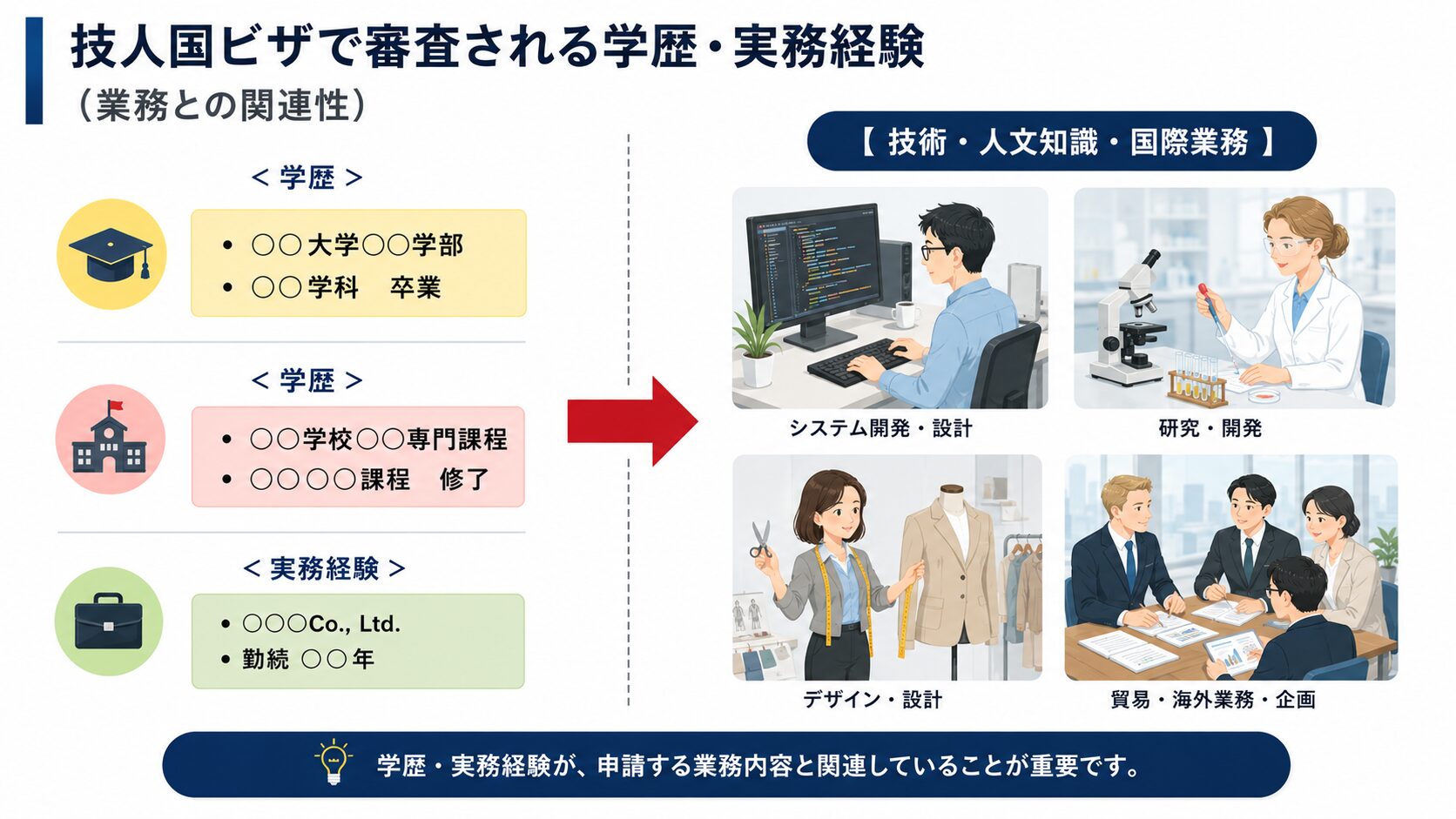
② Relevance of the Field of Work
As a precondition for obtaining the Engineer/Humanities/International visa, the work must require a professional ability above a certain level.
Broadly speaking, this falls into three fields: Engineer (technical), Humanities, and International Services.
In the “Engineer” field, this includes roles such as systems engineers, architects, designers, and mechanical engineers.
In the “Humanities” field, this includes roles such as planning, marketing, accounting, product development, and public relations.
“International Services” includes roles such as translation, interpretation, and language instruction at private schools.
Whether the applicant has the necessary level of ability to perform these duties is reviewed based on academic background and work experience.
Since this is a check for specialized expertise, your academic background and experience need to be relevant to the work you’re about to take on.
Career Changes & Switching Statuses of Residence
Work-related statuses of residence aren’t always a single, permanent fit — they often need to be switched as your career changes. Here are some typical transition patterns.
- Technical Intern Training → Specified Skilled Worker
A common pattern for those who have satisfactorily completed technical intern training and continue working in the same field. A requirement includes having satisfactorily completed Technical Intern Training (ii). - Specified Skilled Worker → Engineer/Specialist in Humanities/International Services
This transition applies to those working under Specified Skilled Worker who move into work that draws on their university major or practical experience. Since the relevance between your major/work history and the new job duties is examined, the review perspective differs from that of Specified Skilled Worker. - Student → Engineer/Specialist in Humanities/International Services
The most common transition pattern for international students who graduate from a Japanese university or vocational school and take a job at a company related to their field of study. - Engineer/Specialist in Humanities/International Services → Highly Skilled Professional
For those who have worked under the Engineer/Humanities/International visa for a certain period, and whose points — calculated from factors like academic background, work history, and annual income — total 70 or more. Moving to Highly Skilled Professional status brings several benefits, including preferential treatment for period of stay and relaxed requirements for permanent residency.
In every case, what you were doing under your previous status, and how clearly the relevance to your new job duties can be explained, are key points in the review. Our office supports preparing application documents that draw on your track record from before the transition.
If you’re unsure which status of residence applies to you,
please check with us first in a free consultation.
Required Documents
The documents required for an Engineer/Humanities/International visa application vary depending on the size and category of the employing organization.
▶ Categories 1 through 4
The classification of each category, and the corresponding required documents, can be checked on the Immigration Services Agency’s website.きます。
Reference:[Official] Immigration Services Agency Website
Points to Watch
- Simply gathering all the listed documents isn’t necessarily enough — in many cases, it’s recommended to attach supplementary materials that demonstrate you meet the status of residence requirements.
- Approval or denial can sometimes come down to how supporting documents and the written explanation (riyūsho) are written.
- Actually preparing these documents requires a high level of skill — checking that there are no contradictions between documents, and that the content addresses the points immigration examiners look for.
If you’re feeling unsure, consider consulting a professional administrative scrivener (gyoseishoshi).
For Companies & Accepting Organizations
We also welcome inquiries from companies and business owners considering hiring foreign talent.
Not sure which status of residence applies to the person you plan to hire
We advise on eligibility for the appropriate status of residence, based on the points examined for the Engineer/Humanities/International visa, such as the relevance between academic/work background and the job duties involved.
Want your employment contract reviewed
We review your contract from a screening perspective — for example, whether the job duties and compensation are clearly stated.
Considering switching a Technical Intern Trainee or Specified Skilled Worker to another status
We also handle consultations about switching those you currently employ under Technical Intern Training or Specified Skilled Worker to another status, such as the Engineer/Humanities/International visa. We’ll guide you through the requirements and documents needed for the transition, based on practical experience.
Accepting foreign talent requires ongoing management of their status of residence even after hiring. HR and general affairs staff are also welcome to reach out with any questions.
Fees
Our fees for these services are as follows (all prices listed include tax).
We welcome inquiries not only from the foreign national applicant, but also from the accepting company.
| Service | Fee | Notes |
|---|---|---|
| Change of Visa Type “Application for Permission to Change Status of Residence” | ¥110,000 | e.g., Student → Work visa, Work → Spousal visa |
| Extend Your Visa “Application for Extension of Period of Stay” | ¥55,000 | When there’s no significant change in circumstances since your last application |
| Extend Your Visa (with a change in circumstances) “Application for Extension of Period of Stay” | ¥104,500 | When circumstances have changed since your last application — e.g., a job change or divorce |
| Inviting a Foreign National From Overseas “Application for Certificate of Eligibility” | ¥121,000 | |
| Application for Permission to Engage in Activity Other Than That Permitted (Student / Dependent) | ¥19,800 | Needed for those on “Student” or “Dependent” status who wish to work part-time, etc. |
| Application for Permission to Engage in Activity Other Than That Permitted (Other) | ¥66,000 | For permission to engage in other activities under statuses not listed above |
Frequently Asked Questions
- How long does the review for an Engineer/Humanities/International visa take?
-
This varies depending on the application content and timing, but as a general guide, it takes around 1 to 3 months. If inviting someone from overseas, this becomes a Certificate of Eligibility application, which requires a separate procedure.
- Can I apply even if my academic background and job duties don’t fully match?
-
If there’s a reasonable degree of relevance between your major and the job duties, approval may be possible even without a perfect match. Since this needs to be checked based on your individual circumstances, please consult us first.
- Can I keep employing a Technical Intern Trainee by switching them to an Engineer/Humanities/International visa?
-
Yes, if the job duties and academic background requirements are met. However, since Technical Intern Training and the Engineer/Humanities/International visa are reviewed from different perspectives, we recommend consulting us in advance about the outlook for the switch.
- This is our first time hiring a foreign national — can we still consult you?
-
Yes, absolutely. From checking the status of residence of the person you plan to hire, to reviewing the employment contract, to preparing the required documents, we support you so that even a first-time hire can proceed with confidence.
Start With a Free Consultation — Feel Free to Reach Out
A work visa application involves many points to confirm — from whether the status of residence applies to how documents should be prepared. Whether you’re the foreign national applicant or the accepting company/employer, please start by telling us about your situation in a free consultation.
Book Your Free Initial Consultation
Using the web form above is the smoothest way to contact us or book a consultation.
※For urgent inquiries, you’re also welcome to call us at 076-218-9852.